Home › Pest Library › American Cockroach
Cockroach identification guide
American Cockroach (Palmetto Bug): How to Identify It and What to Do
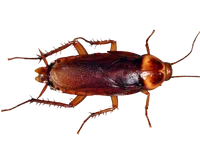
The American cockroach is the big one: about 2 inches long, chestnut to light brown, with pale outer margins on the plate behind the head. UGA says it lives mainly in sewers and other dark, damp hideaways such as basements and is rarely, if ever, found in attics. University of Florida entomologists note it is often called a “palmetto bug.”
Last reviewed October 7, 2026. Sources are listed at the end of the page.
Identification
Is it an American cockroach? Compare the large roaches
Three large roaches are easy to mix up. UGA lists them as look-alikes of each other, so compare size, color and where you found it.
| Cockroach | Size and color | Where it lives |
|---|---|---|
| American | About 2 in.; chestnut to light brown, with pale outer margins on the pronotum (the plate behind the head). Males and females look alike | Sewers and other dark, damp hideaways such as basements. Rarely, if ever, found in attics. Active at night |
| Smokybrown | About 1.5 in.; uniformly dark cherry to dark red | Treeholes, attics, crawlspaces, sheds and similar humid harborages. The most common roach in Southern suburban neighborhoods with mature hardwood trees. Rarely, if ever, found in sewers |
| Oriental | About 1 to 1.25 in.; cherry to black. Females are wingless | Outdoor harborages; rarely found around suburban homes |
About the name: UF/IFAS says the American cockroach is often called a “palmetto bug.” It is a regional nickname, so go by the size and markings above. If the roach is small and tan with two stripes behind the head, see the German cockroach guide instead.
Where American cockroaches live
UGA says American cockroaches live mainly in sewers and other dark, damp hideaways such as basements, and are sometimes found sharing outdoor harborage with smokybrown and Oriental cockroaches. They are active at night.
Damp, dark spaces
Basements, sewers and other dark, damp hideaways are the places UGA names for this species.
Not an attic roach
UGA says American cockroaches are rarely, if ever, found in attics. A large roach in an attic is more likely a smokybrown cockroach.
Wings, but not strong fliers
UF/IFAS says both sexes are poor to average fliers. The wings of the male typically extend beyond the abdomen, while those of the female do not.
UGA also notes that excessive, persistent moisture is the most important condition that lets many pest problems establish and persist, so a damp basement or crawlspace is worth fixing whichever roach you find.
Life cycle: why one big roach is not the whole story
UF/IFAS reports that an American cockroach egg case contains 14 to 16 eggs and that a female produces nine to ten such cases in her lifetime. The nymphs molt 10 to 13 times, and UF/IFAS says an individual may live well over a year. That slow, long life cycle is one reason a big roach you see today may have been living nearby for some time.
What UGA says works
- Bait where the roaches are. UGA says to apply gel baits in multiple small dabs no larger than a pea, or to broadcast granular baits, in areas where cockroaches are found, following the label.
- Know the limit of bait stations. UGA says stations can control small nymphs, but adults and large nymphs may be too big to fit into the small openings in most stations.
- Seal the way in. UGA recommends sealing cracks, gaps and entryways, adding door sweeps and window screens, and screening foundation and attic vents.
- Dry it out. Ventilate attics, crawlspaces and basements, and direct rainwater, gutters, downspouts and air-conditioner condensate away from the foundation.
- Keep the yard tidy near the house. UGA says to keep groundcovers at least 1.5 feet from the foundation walls and to limit mulch depth.
When to call a professional
Call if large roaches keep appearing indoors, if you cannot tell which species you have, or if baiting has not stopped them. A professional can identify the roach, find the damp spots and entry points drawing it in, and treat the areas where it is active. Pest Control Atlanta does this for homes and businesses, and our service carries a “Satisfaction Guaranteed — Free Re-Treatment If Pests Return” guarantee.
Common questions
Frequently asked questions
Is a palmetto bug the same as an American cockroach?
UF/IFAS says the American cockroach is often called a “palmetto bug.” The name is regional and loose, so identify the roach by size and markings. UGA lists the American cockroach at about 2 inches with pale outer margins on the pronotum.
Can American cockroaches fly?
UF/IFAS says both sexes are poor to average fliers. The male's wings extend beyond the abdomen, while the female's do not.
Are American cockroaches found in attics?
UGA says American cockroaches are rarely, if ever, found in attics. Smokybrown cockroaches are the ones UGA places in attics, treeholes, crawlspaces and sheds.
How many eggs does an American cockroach lay?
UF/IFAS reports 14 to 16 eggs per egg case, and nine to ten cases over a female's lifetime.
Do bait stations work on adults?
UGA says bait stations can control small nymphs, but adults and large nymphs may be too big to fit into the small openings in most stations. It recommends gel baits in small dabs or granular baits where the roaches are found.
Why do I see one in my bathroom or basement?
UGA describes the American cockroach as a species of sewers and dark, damp hideaways such as basements, so moisture and gaps are the usual draw. Sealing entry points and drying out damp areas are the long-term fixes UGA recommends.
Where this information comes from
Sources
Facts about identification, biology and safety come from the sources below, retrieved on October 7, 2026. Publication or review dates are given where the source shows one.
- Cockroaches (order Blattaria), UGA Integrated Pest Management — by Suiter, Forschler, Ames and Hoebeke, September 21, 2022
- Insect and Arthropod Pests of Southeastern Neighborhoods: A Guide to Identification and Management (Bulletin 1412), UGA Extension — revised June 2023 per the PDF; the UGA page lists October 20, 2023
- American cockroach, Periplaneta americana, University of Florida Entomology and Nematology (UF/IFAS cockroach photographs) — copyright 2005; used for the nickname, flight and egg-case details
More identification guides
Browse the full Atlanta Pest Library, or read another identification guide:
Large roaches keep turning up inside?
Call Pest Control Atlanta to talk through what you are seeing. We can inspect, identify the species and find what is drawing it in.
Call Pest Control Atlanta (404) 647-6677Licensed & Insured company. Serving Atlanta and surrounding areas. Available 24/7 for calls, bookings and on-site service.